
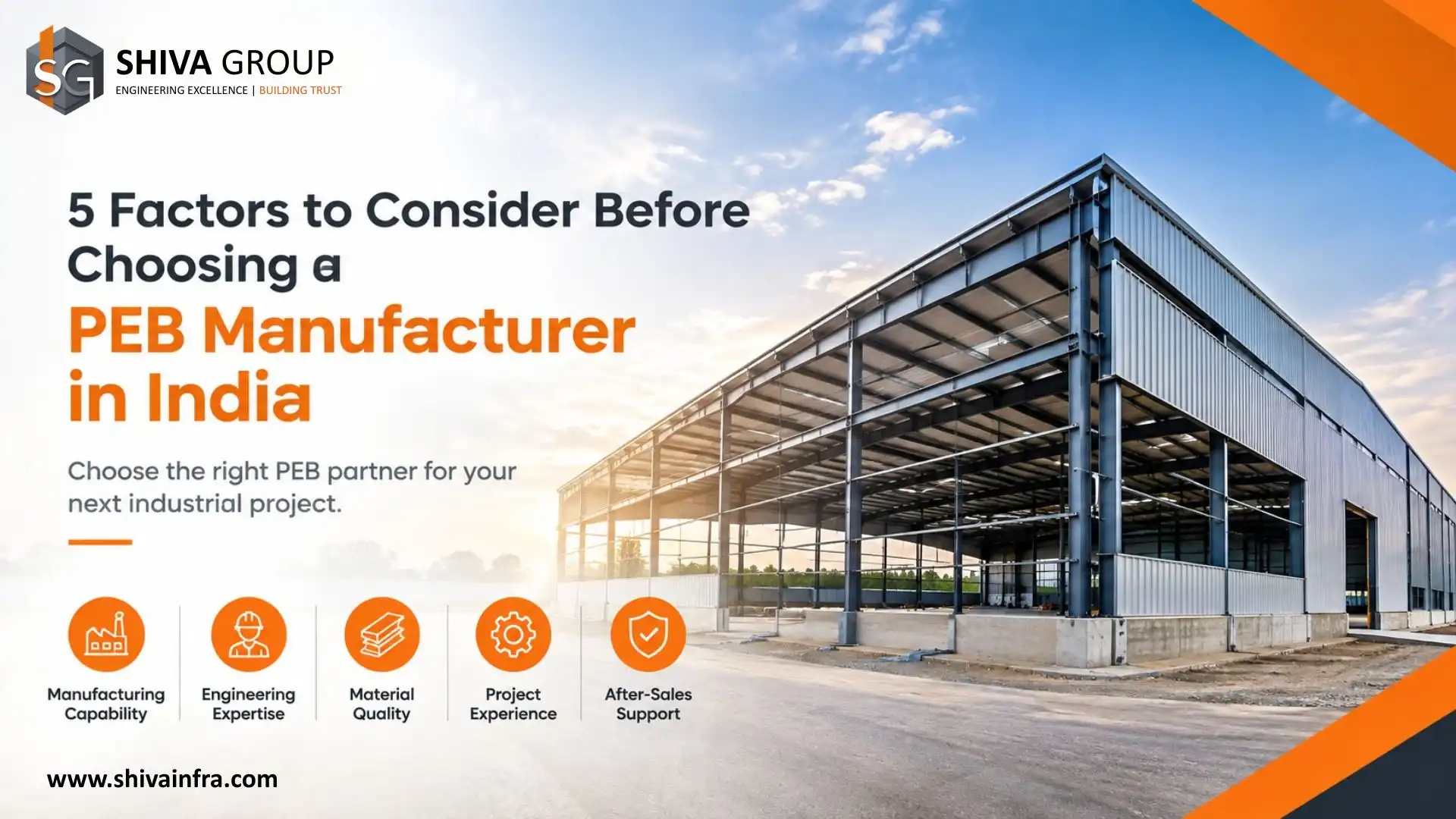
Selecting the right PEB manufacturer in India is one of the most important decisions when planning an industrial, warehouse, manufacturing, logistics or infrastructure project. A pre-engineered building is not simply a collection of steel components that is manufactured in a factory and assembled at the site. It is a complete engineered building system where design, material selection, fabrication, quality control, transportation and erection all need to work together.
For a project owner, the quotation is naturally an important part of the decision. However, the lowest price does not always represent the lowest overall project cost. Differences in engineering quality, steel specifications, fabrication accuracy, project coordination and site execution can have a significant effect on the final outcome.
This is why choosing a PEB partner should involve a broader evaluation of technical capability, manufacturing infrastructure, previous experience and execution support.
Whether you are planning a warehouse, factory, industrial shed, manufacturing facility, workshop or another large-span steel building, the following five factors can help you evaluate a PEB manufacturer more effectively.
What Is a PEB Manufacturer?
Before discussing the selection process, it is useful to understand what a PEB manufacturer actually does.
A Pre-Engineered Building (PEB) is a steel building system in which the structural components are designed and fabricated according to the requirements of a particular project. The major components are manufactured under controlled factory conditions and then transported to the project site for assembly.
Depending on the project scope, a PEB system can include primary structural frames, secondary members, roofing and wall cladding systems, bracing, fasteners, accessories and other building components.
The process generally involves several stages:
- Understanding the project requirements
- Structural engineering and design
- Preparation of detailed drawings
- Material procurement
- Steel fabrication
- Quality inspection
- Surface treatment and finishing
- Packing and transportation
- Site erection
- Final inspection and handover
This means that the manufacturer’s responsibility can extend far beyond steel fabrication.
A capable PEB company should be able to coordinate these stages properly so that the building delivered at the site matches the approved engineering requirements.
1. Check the Manufacturer’s Manufacturing Capability
One of the first things to evaluate is the manufacturer’s actual manufacturing infrastructure.
A PEB manufacturer may have an impressive website and portfolio, but the more important question is whether its manufacturing facility has the capacity and processes required for your particular project.
Large industrial projects can involve significant quantities of structural steel, multiple building sections, complex connections, large spans and strict delivery schedules. Manufacturing capability therefore has a direct connection with project execution.
What should you check?
Consider the following points before finalizing a manufacturer:
- Factory production capacity
- Fabrication equipment
- Welding facilities
- Cutting and drilling systems
- Material handling arrangements
- Quality inspection facilities
- Production planning process
- Storage and dispatch capability
- Ability to manufacture customized structures
- Capacity to handle projects according to the required schedule
The objective is not simply to find the biggest manufacturing facility. The objective is to find a facility that is suitable for the scale, complexity and schedule of your project.
Why manufacturing capability matters
PEB construction relies heavily on precision. Components manufactured incorrectly or outside the required tolerances can create problems during transportation and erection.
For example, if a connection plate, opening or structural member does not match the approved drawings, the issue may only become obvious when the component reaches the site. Correcting such problems can result in additional time, labour and transportation costs.
A properly organized manufacturing process helps reduce these risks.
It is also worth asking whether the manufacturer can provide production updates and quality documentation during the project. Good communication between the factory and project team makes it easier to identify and address issues before they reach the construction site.
2. Evaluate Engineering and Design Expertise
Manufacturing capability alone is not enough.
A PEB structure begins with engineering. The building needs to be designed according to its intended use, dimensions, loading conditions, site conditions and project requirements.
This makes the engineering team one of the most important factors when choosing a PEB manufacturer.
A manufacturer with a strong engineering setup should be able to understand the complete project requirement rather than treating the building as a standard product.
Important areas of PEB engineering include:
- Structural analysis
- Building geometry
- Primary frame design
- Secondary member design
- Connection design
- Roof and wall system selection
- Crane requirements
- Openings and equipment requirements
- Wind and other applicable design loads
- Future expansion requirements
- Fabrication drawings
- Erection drawings
- Coordination with civil and architectural requirements
The engineering team should also be able to coordinate with consultants, architects, civil contractors and other project stakeholders.
Why engineering matters
Two buildings with the same length and width may not necessarily have the same structural requirements.
The final design can change depending on factors such as:
- Building height
- Span
- Bay spacing
- Location
- Wind conditions
- Seismic considerations
- Crane loads
- Equipment loads
- Roof requirements
- Wall cladding
- Internal operations
- Future expansion plans
Therefore, simply comparing the steel price per tonne or a basic price per square foot may not provide a complete picture.
The engineering approach behind the structure matters.
In India, structural design also needs to consider applicable Indian standards and project-specific requirements. Relevant steel and loading standards include standards such as IS 800 and IS 875, along with applicable seismic design requirements where relevant.
Ask about in-house engineering capability
When evaluating a manufacturer, ask:
Does the company have an experienced engineering team?
Also ask whether the engineering team works directly with the manufacturing and project execution teams.
Strong coordination between engineering and fabrication can reduce design errors, drawing revisions and site-related issues.
3. Look Carefully at Material Quality and Quality Control
The quality of a PEB structure depends not only on the design but also on the materials used and the processes followed during fabrication.
This is an area where project owners should look beyond general statements such as “high-quality steel.”
Ask specific questions about material specifications, inspection procedures, traceability and quality documentation.
Important areas to review include:
- Structural steel specifications
- Material certificates
- Material traceability
- Plate and section inspection
- Welding procedures
- Weld inspection
- Dimensional inspection
- Surface preparation
- Painting or coating system
- Fasteners and accessories
- Roofing and cladding materials
- Quality-control documentation
A systematic quality-control process helps ensure that the fabricated components correspond to the approved design.
Material quality is not just about steel grade
A building’s long-term performance depends on more than the basic grade of structural steel.
The overall system includes:
- Structural members
- Bolted connections
- Secondary framing
- Roofing
- Wall cladding
- Flashings
- Fasteners
- Insulation where required
- Protective coating
- Accessories
These components need to work together.
For projects located in areas where corrosion exposure is a concern, the appropriate surface protection and coating system should also be considered as part of the project requirements.
Ask for documentation
Before finalizing a PEB manufacturer, ask what quality documents will be provided during the project.
Depending on the project, documentation may include material test certificates, inspection reports, approved drawings, fabrication records and other quality-related documents.
A manufacturer that follows a structured quality process should be able to clearly explain how materials and fabricated components are inspected.
4. Check Relevant Project Experience
Experience is another important factor, but it should be evaluated carefully.
A company may have completed many projects, but the more useful question is:
Has the manufacturer handled projects similar to yours?
A warehouse, a manufacturing plant, a steel plant structure and a specialized industrial building can have very different requirements.
Look for experience relevant to your project
Depending on your requirement, relevant experience may include:
- Industrial sheds
- Manufacturing facilities
- Warehouses
- Logistics facilities
- Steel plants
- SMS-related structures
- Workshops
- Railway infrastructure
- Large-span structures
- Commercial buildings
- Institutional buildings
- Industrial expansion projects
If your project includes cranes, heavy equipment, special loading conditions or future expansion, experience with similar requirements becomes even more valuable.
Don’t just look at the project count
When reviewing a manufacturer’s portfolio, try to understand:
- Project size
- Type of structure
- Structural span
- Industry
- Location
- Scope of work
- Manufacturing responsibility
- Erection responsibility
- Project completion status
This gives you a better understanding of whether the manufacturer’s experience matches your actual requirements.
Ask for relevant project references
Where appropriate, you can ask the manufacturer to share examples of completed projects similar to yours.
For instance, if you are developing a large manufacturing facility, a portfolio dominated by small commercial structures may not tell you much about its ability to handle your project.
Relevant experience provides more useful information than a large project-count figure without context.
5. Understand Execution, Erection and After-Sales Support
A PEB project does not end when the steel components leave the factory.
Transportation, site coordination and erection are equally important parts of the overall process.
Even a well-engineered and accurately fabricated building can face difficulties if the erection process is poorly coordinated.
This is why you should clearly understand the manufacturer’s role after fabrication.
Questions to ask include:
- Is erection included in the project scope?
- Who will coordinate transportation?
- Who will provide erection drawings?
- What technical support is available at the site?
- How are site issues handled?
- Who is responsible for rectification if a problem occurs?
- What documentation is provided after completion?
- Is technical support available after handover?
- Can the manufacturer support future modifications or expansion?
Site execution matters
PEB erection requires proper sequencing and coordination.
Structural components need to arrive at the site in a logical sequence. Storage, lifting equipment, access, manpower and site conditions all influence erection progress.
If materials arrive without proper planning, the site may experience unnecessary handling, storage problems or delays.
A manufacturer with experience in project execution can help coordinate the transition from factory production to site installation.
After-sales support
Industrial buildings are long-term assets. During their operating life, owners may require technical assistance for modifications, extensions, replacement of components or other requirements.
A manufacturer that remains available for technical support after project completion can therefore be a useful long-term partner.
Price Should Not Be the Only Selection Criteria
Price will always be an important part of a construction decision. However, comparing PEB quotations only on the final amount can be misleading.
Two quotations may appear similar while covering different specifications and scopes.
For example, one quotation may include:
- Higher-grade materials
- Better coating specifications
- More accessories
- Engineering services
- Erection support
- Transportation
- Quality documentation
while another may exclude some of these items.
This is why quotations should be compared on a like-for-like basis.
Compare these areas before making a decision:
| Evaluation Area | What to Check |
|---|---|
| Engineering | Design scope, drawings and technical support |
| Steel | Specifications, grades and quantities |
| Manufacturing | Production capability and quality process |
| Roofing | Profile, thickness, coating and insulation |
| Cladding | Material specifications and finish |
| Connections | Bolts, fasteners and connection details |
| Painting | Surface preparation and coating system |
| Accessories | Flashings, gutters, louvers and other items |
| Transportation | Scope and delivery arrangements |
| Erection | Labour, equipment and technical supervision |
| Quality | Inspection and documentation |
| Warranty | Terms and coverage |
| Future Expansion | Design provisions and technical support |
A transparent comparison can help prevent unexpected costs later in the project.
Questions to Ask Before Finalizing a PEB Manufacturer in India
If you are currently evaluating PEB companies in India, the following checklist can help.
About the company
- How long has the company been involved in PEB and steel construction?
- What types of projects has it completed?
- Does it have experience in your industry?
About engineering
- Does the company have an in-house engineering team?
- How are structural designs prepared and reviewed?
- How are project-specific requirements incorporated into the design?
About manufacturing
- Where is the manufacturing facility located?
- What is its production capacity?
- What quality-control systems are followed?
- How are fabricated components inspected before dispatch?
About materials
- What steel specifications are proposed?
- How is material quality verified?
- What coating or corrosion-protection system is recommended?
- What roofing and cladding specifications are included?
About execution
- Is erection included in the quotation?
- Who handles transportation?
- What technical support is available during erection?
- How are site modifications or fabrication issues handled?
About the final quotation
- What exactly is included in the quoted price?
- What items are excluded?
- What is the expected manufacturing and delivery schedule?
- What payment terms apply?
- What documentation will be provided?
- What support is available after completion?
Getting clear answers to these questions can make the procurement process more transparent.
PEB Manufacturer in India vs PEB Supplier in India: Why the Difference Matters
The terms “PEB manufacturer” and “PEB supplier” are sometimes used interchangeably, but project owners should understand what a company actually handles.
A manufacturer generally has responsibility for engineering and/or fabrication through its own manufacturing infrastructure, depending on the agreed scope.
A supplier may procure components from other manufacturers and coordinate their delivery.
Neither model automatically determines whether a company is suitable for a project. What matters is understanding who is responsible for engineering, fabrication, quality control, logistics and execution.
For a large industrial project, clarity around these responsibilities is particularly important.
Before signing a contract, ensure that the complete scope is clearly documented.
How to Choose the Right PEB Partner for Your Project in India
There is no single PEB manufacturer that will be suitable for every project.
The right choice depends on your building requirements, project location, budget, schedule, structural design, industry, operating conditions and scope of work.
A practical selection process can follow these steps:
Step 1: Define your project requirements
Prepare basic information about:
- Building dimensions
- Location
- Purpose
- Required clear height
- Span
- Bay spacing
- Crane requirements
- Roofing and cladding requirements
- Expected project timeline
- Future expansion requirements
Step 2: Shortlist relevant manufacturers
Look for companies with experience in projects similar to yours.
Step 3: Evaluate technical capability
Review engineering, manufacturing infrastructure, quality procedures and project execution capabilities.
Step 4: Compare quotations properly
Make sure the quotations use comparable specifications and clearly identify inclusions and exclusions.
Step 5: Review previous projects
Look for relevant project experience rather than relying only on total project numbers.
Step 6: Clarify execution responsibilities
Document who is responsible for transportation, erection, supervision, technical support and handover.
Step 7: Review the final agreement
Make sure specifications, drawings, timelines, quality requirements, payment terms and responsibilities are clearly documented.
Why PEB Is Suitable for Many Industrial Projects in India
PEB systems are widely considered for applications where speed, large usable spaces, structural flexibility and controlled fabrication are important.
Typical applications include:
- Manufacturing plants
- Warehouses
- Logistics buildings
- Industrial sheds
- Workshops
- Storage facilities
- Steel industry structures
- Railway-related facilities
- Commercial and institutional buildings
- Large-span structures
One of the major advantages of the PEB approach is that much of the structural fabrication can take place away from the construction site while foundation and other site activities progress in parallel. This can help reduce the overall site programme when the project is properly planned.
However, PEB should not be treated as an automatic solution for every building. The suitability of the system depends on the project’s structural, architectural, operational and site-specific requirements.
Common Mistakes to Avoid When Selecting a PEB Manufacturer in India
Choosing a manufacturer based only on the lowest price is one of the most common mistakes.
Other mistakes include:
1. Ignoring engineering capability
A good-looking building quotation does not tell you how strong the manufacturer’s engineering process is.
2. Comparing only steel tonnage
Lower steel weight does not automatically mean better engineering. The complete design and performance requirements need to be considered.
3. Not checking material specifications
Make sure the proposed material specifications are clearly mentioned in the quotation and technical documents.
4. Ignoring erection scope
Clarify whether erection, supervision, transportation and equipment are included.
5. Not considering future expansion
If the facility may need expansion later, discuss this during the initial design stage.
6. Choosing without reviewing relevant projects
A manufacturer experienced in similar projects can provide more relevant evidence of its capabilities.
7. Not documenting exclusions
Unclear exclusions can result in additional costs during execution.
Choosing a PEB manufacturer in India is a technical and commercial decision that deserves careful evaluation.
Manufacturing infrastructure, engineering expertise, material quality, relevant project experience and execution support should all be considered before finalizing a PEB partner.
The best evaluation is not simply about asking, “Who has the lowest quotation?”
A better question is:
Which manufacturer can deliver the required structure with the right engineering, quality, coordination and project support for our specific requirements?
When these factors are evaluated together, project owners can make a more informed decision and reduce the risk of unexpected issues during fabrication and erection.
For industrial and infrastructure projects, a PEB manufacturer should be viewed not only as a steel supplier but as an engineering and execution partner.
About Shiva Infra Solutions Pvt. Ltd.
Shiva Infra Solutions Pvt. Ltd. provides engineered PEB and steel structure solutions for industrial and infrastructure requirements. The company’s capabilities cover engineering, fabrication and project execution for applications including industrial buildings, warehouses, manufacturing facilities and other steel structure requirements.
With the right combination of engineering, manufacturing and execution planning, a PEB structure can be developed around the actual needs of the project rather than treated as a standard building product.
If you are planning a new industrial building, warehouse, manufacturing facility or PEB structure, discuss your project requirements with an experienced PEB team before finalizing the design and manufacturer.
PEB Manufacturer Selection Checklist
Before choosing a manufacturer, confirm:
☐ Engineering capability
☐ Manufacturing capacity
☐ Steel specifications
☐ Quality-control process
☐ Previous project experience
☐ Roofing and cladding specifications
☐ Transportation scope
☐ Erection scope
☐ Project timeline
☐ Warranty terms
☐ Documentation
☐ After-sales support
Need help evaluating your PEB requirement? Contact Shiva Infra Solutions.
Let's Build Your Next Industrial Project
Frequently Asked Questions
1. How do I choose a PEB manufacturer in India?
Look at the manufacturer’s engineering capability, manufacturing infrastructure, material quality, relevant project experience, quality-control process and ability to support transportation and erection. Comparing quotations on a like-for-like technical basis is also important.
2. What should I check before selecting a PEB manufacturer?
Check the company’s engineering team, manufacturing capacity, quality-control procedures, material specifications, previous projects, erection capability, delivery schedule, documentation and after-sales technical support.
3. Should I choose a PEB manufacturer based only on price?
Price is an important consideration, but it should not be the only selection criterion. PEB quotations can differ in structural specifications, engineering scope, steel quantity, roofing and cladding, accessories, transportation, erection and other inclusions. Comparing quotations on a like-for-like technical basis can provide a more meaningful cost comparison.
4. What types of projects can use PEB structures?
PEB structures can be used for applications such as warehouses, manufacturing facilities, industrial sheds, logistics buildings, workshops and various other large-span industrial and commercial structures, depending on project-specific engineering requirements.
5. What information should I provide to a PEB manufacturer for a quotation?
Useful information includes project location, building dimensions, proposed use, approximate built-up area, clear height, crane requirements, architectural drawings, site information and expected project timeline. Additional technical information may be required depending on the project.